Lost Connections by Johann Hari
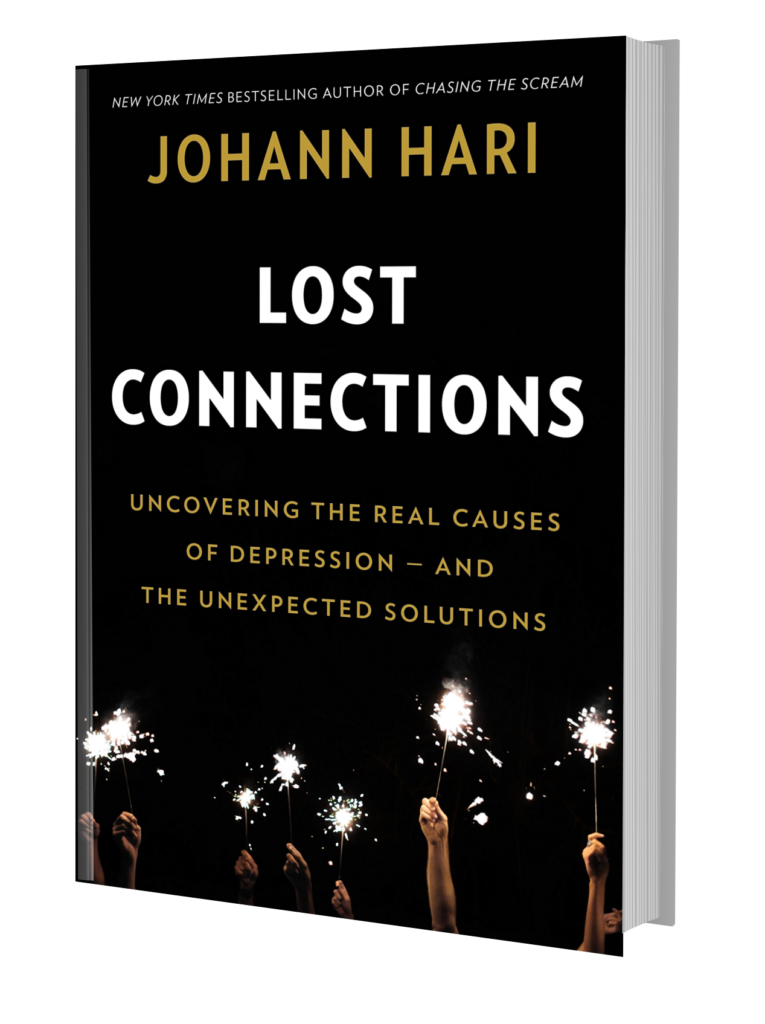
Back in 2018, I came across an interview on the Ezra Klein podcast in which an author named Johann Hari was discussing his upcoming book, Lost Connections: Uncovering the Real Causes of Depression - And the Unexpected Solutions. I was clinically depressed at the time and their conversation really resonated with me. For the first time I felt that I had some understanding of why I was feeling the way I was. It gave me a better story to tell about my depression and what I was dealing with than the one I already had. Their conversation helped me realize that depression was much more than just a chemical imbalance in your brain. It wasn’t a sign that there was something wrong with me, rather it was a sign that there was something wrong with my life.
I immediately bought Hari’s book when it came out, and I eagerly jumped into it. It did not disappoint. It starts with a critique of the serotonin-imbalance model of depression. Hari demonstrates how there was never a consensus among therapists and brain scientists that depression was caused by low levels of serotonin. He also discusses how studies on selective serotonin reuptake inhibitors (SSRIs) consistently showed that these pills were only marginally more effective than placebos. Some people would start to feel a bit better when taking an SSRI, but within a year half of those people were back to feeling the same level of depression as they were before. Some would get a higher dosage from their doctors, or be switched to a different medication, and oftentimes the pattern would repeat itself. A short-term gain, which then dissipated over time. So, serotonin levels cannot explain, at least on their own, why people become depressed. There has to be more going on.
This realization led Hari to look into other causes of depression. By speaking with experts all around the world, he was able to identify several other contributing factors. He also identified a throughline that connects all of these non brain chemical causes: namely, that we’re losing connection with things that are essential for the human animal to thrive. The problem isn’t with our brains. The problem is instead with the lives we are living.
Modernity has brought with it many incredible things, like anesthesia and indoor plumbing, but it has also brought with it many changes that are not necessarily good for us. We have lost our connections to meaningful work and values, to status and respect, to nature and to a hopeful view of the future. We spend more time alone now than we used to, have fewer friends, live further away and interact less frequently with our family and with our community. Technology has allowed us to stay superficially connected with our friends and family, regardless of where we are all living. However this kind of connection doesn’t replace being together in real life.
So, we have a world that gives us something resembling what we need, but only in a superficial way. Pictures and videos of nature, rather than actually being out in nature. Office jobs that are “productive”, but what is produced is abstract and seemingly unimportant. Video calls and online video game sessions that are convenient but don’t have the same impact as being in the same room with our people. These facsimiles of what we need are like junk food: easier, satisfying in the short-term, and designed to get us to choose them over more wholesome fare. And just like with junk food, you’re going to become unhealthy if they’re all that you get. That’s what depression is. Not a chemical imbalance dictated by your genes, but an understandable response to a life that is not giving you all of what you need.
This is ultimately a good thing, because if the problem isn’t with your genes, but is instead with certain aspects of your life, then you can affect it. You can change your life and start feeling better. What I really liked about this book is that it is hopeful. Relatively small changes can have really positive effects. Reconnecting with work that matters to you, with family and friends in real life, with nature, with your values, can all result in changes that you can feel. That’s what this book is all about, recognizing the actual causes of depression and coming up with a plan to treat them, rather than trying to just treat the symptoms.
I think Lost Connections is a wonderful exploration of why we become depressed and what we can do about it. I really recommend it to anyone who wants to understand why they, or someone they care about, is feeling depressed. It really spoke to me when I was depressed, and helped me come up with a truer story as to why I was depressed, and a plan to feel better. I honestly cannot recommend this book enough.